A short history
From service drive to vicarage to home.
In 1889, the financier Joel Hurt strung Atlanta's first electric streetcar line east of downtown and laid out, at its terminus, a planned residential garden suburb he called Inman Park. The lots came with a covenant: nothing built on them could cost less than three thousand dollars — well over half a million in today's money — ensuring, for twenty years, that only the city's wealthiest could move in.
The covenant expired in 1909. By the 1920s the automobile had begun pulling the old money north toward Buckhead and Druid Hills, and the neighborhood's wide lots and former carriage parcels were available for a different kind of building. Speculative developers carved up the open ground — including The Mesa, the stretch of pasture, stables, and private tennis courts that belonged to Ernest Woodruff (then president of the syndicate that had just bought the Coca-Cola Company from the Candler family for twenty-five million dollars). Woodruff's own house still stands at 908 Edgewood, a block away.
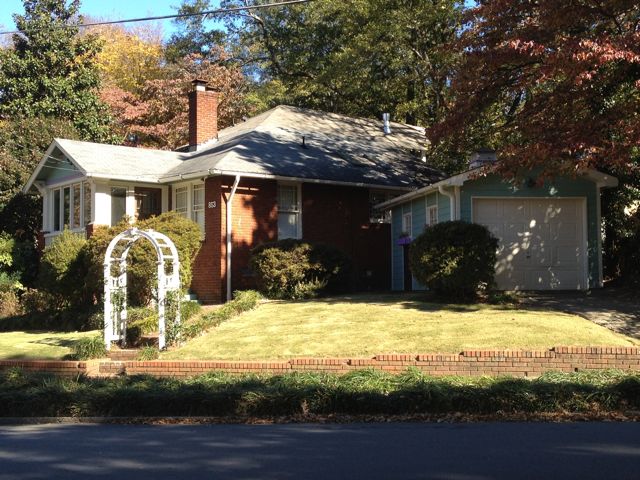
853 Euclid was put up on the Mesa in 1930, on what had been the service drive at the back of the Woodruff property — the lane down which coal, ice, and feed for the horses had been delivered. The original footprint was modest, about nine hundred square feet of brick under a low gable: two bedrooms, one bath, the kind of working-class infill that diversified the neighborhood out of its founders' intentions.
By the 1950s Inman Park had fallen hard. Mansions were partitioned into rooming houses; banks redlined the streets. Through that decade and into the next, 853 Euclid served as the vicarage for Lizzie Chapel, the church directly across the street — an anchor of one kind while the neighborhood looked for another.
The turn came in 1969 when the designer Robert Griggs bought the wrecked Beath-Dickey house at 866 Euclid for twenty-two thousand dollars and rallied forty other “urban pioneers” to buy and restore the block. To prove what they had done, and to push back against the redlining, they organized the first Inman Park Festival and Tour of Homes in the early 1970s. 853 Euclid has appeared on the Tour twice. The neighborhood was placed on the National Register of Historic Places in 1973.
Elliot Stivers bought the house in 1998 and, with Scarlett Lyda, has spent the years since carefully roughly doubling it — an enclosed front porch, a kitchen extension, a finished half-basement, and a second floor that adds a master bedroom, master bath, and a screened-in porch on its eastern face. The house is now 1,883 square feet, and somehow none of it feels new.
Reading Nook
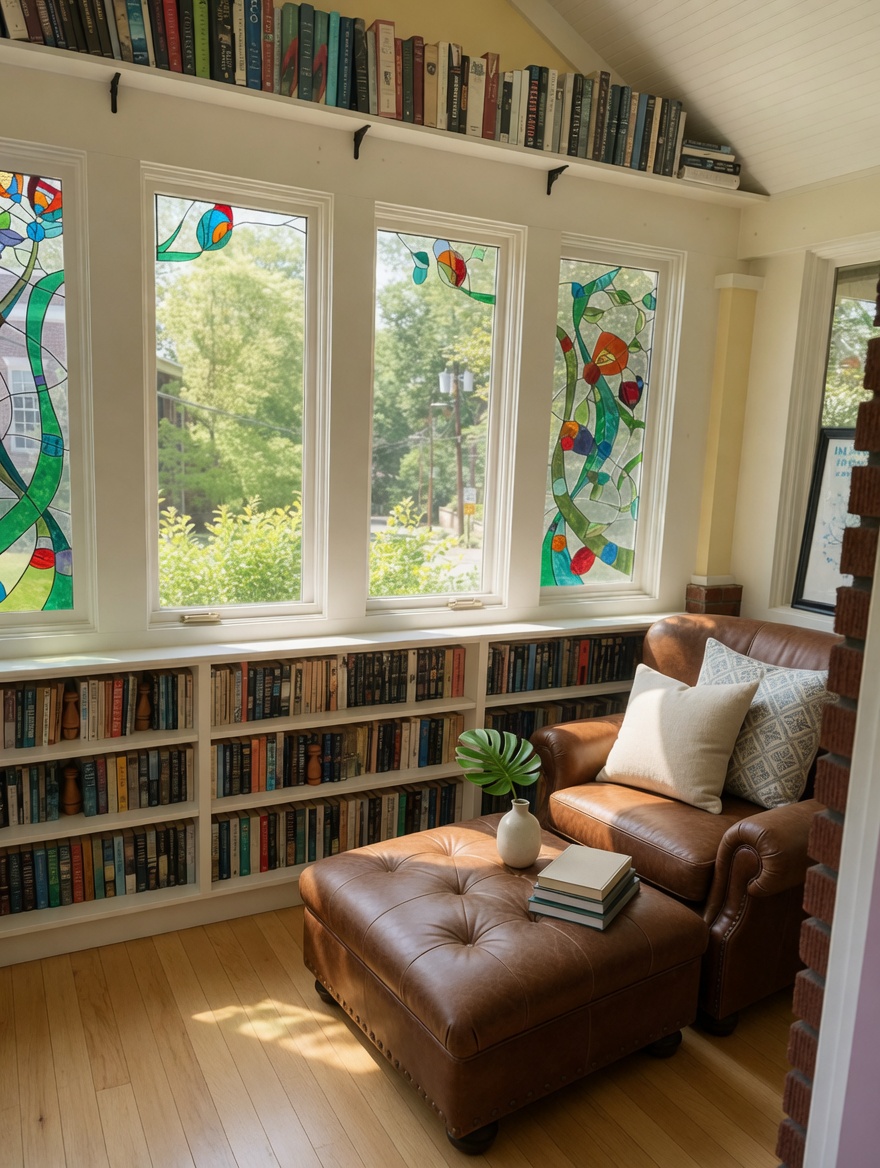
The enclosed front porch, now the quietest room in the house.
A vaulted ceiling, three custom stained-glass panels — sinuous green vines threading multicolored glass beads, more art nouveau than ecclesiastical — sit above a deep run of white built-ins packed with paperbacks. A second shelf rides the eaves at ceiling height, books displayed like trophies above the windows.
The seating is one piece doing all the work: a worn brown leather club chair with matching tufted ottoman, art books staged on top, a single monstera leaf in a thumb-thrown vase. Exposed brick on the right hints at a chimney kept in place during the porch conversion. Floors are warm pale oak — the room reads bright but never sterile.
Living Room
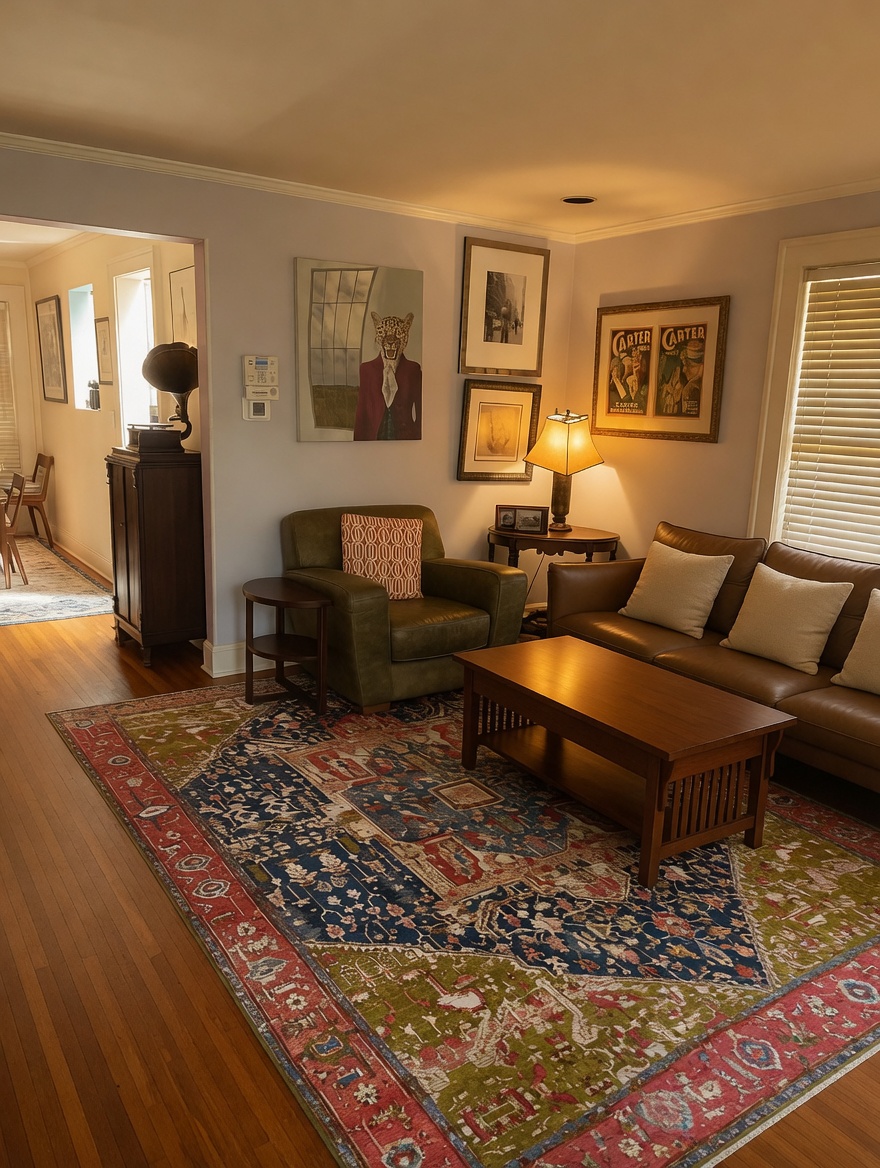
The jaguar in the tailored suit presides.
Lavender-grey walls, brown leather sectional, olive leather armchair, brass-stem lamp glowing warm against an early-evening register. A Mission-style oak coffee table anchors a Persian rug in navy, oxblood, and moss.
The art does the talking — a portrait of a jaguar in a tailored suit (gaze unsettling, lapels impeccable) presides over the room, flanked by two Carter the Great magician posters from the 1900s. The kind of pairing that signals the homeowner finds the showmen funnier than the predator. A vintage globe and dark mahogany sideboard close the gallery wall; the doorway leads through to the dining area.
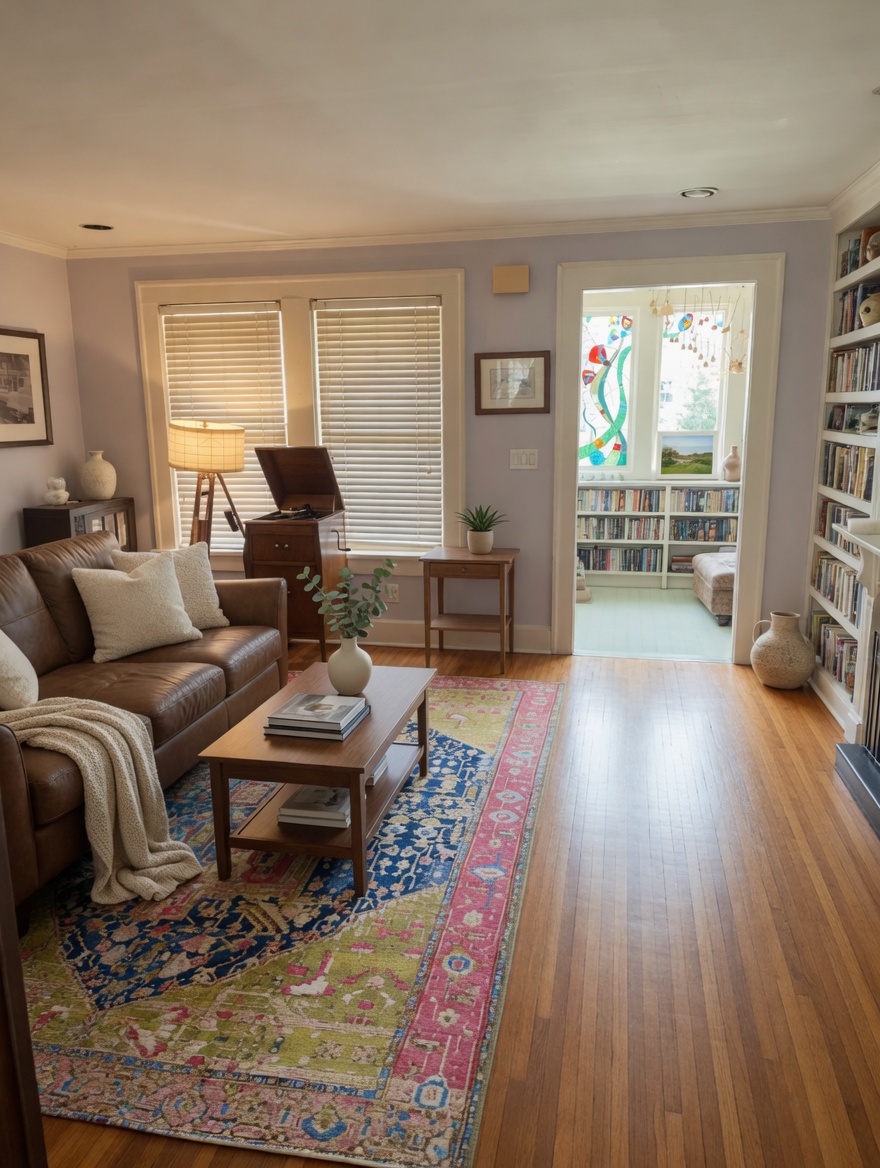
By morning the same room reads completely different: blinds open, cream throw on the sofa, vintage radio console tucked under the window, a rose-and-cobalt rug warmer than the evening one. The doorway to the reading nook frames dead center, the stained glass visible through it like a portal. Built-in white shelves continue down the right wall.
Dining Room
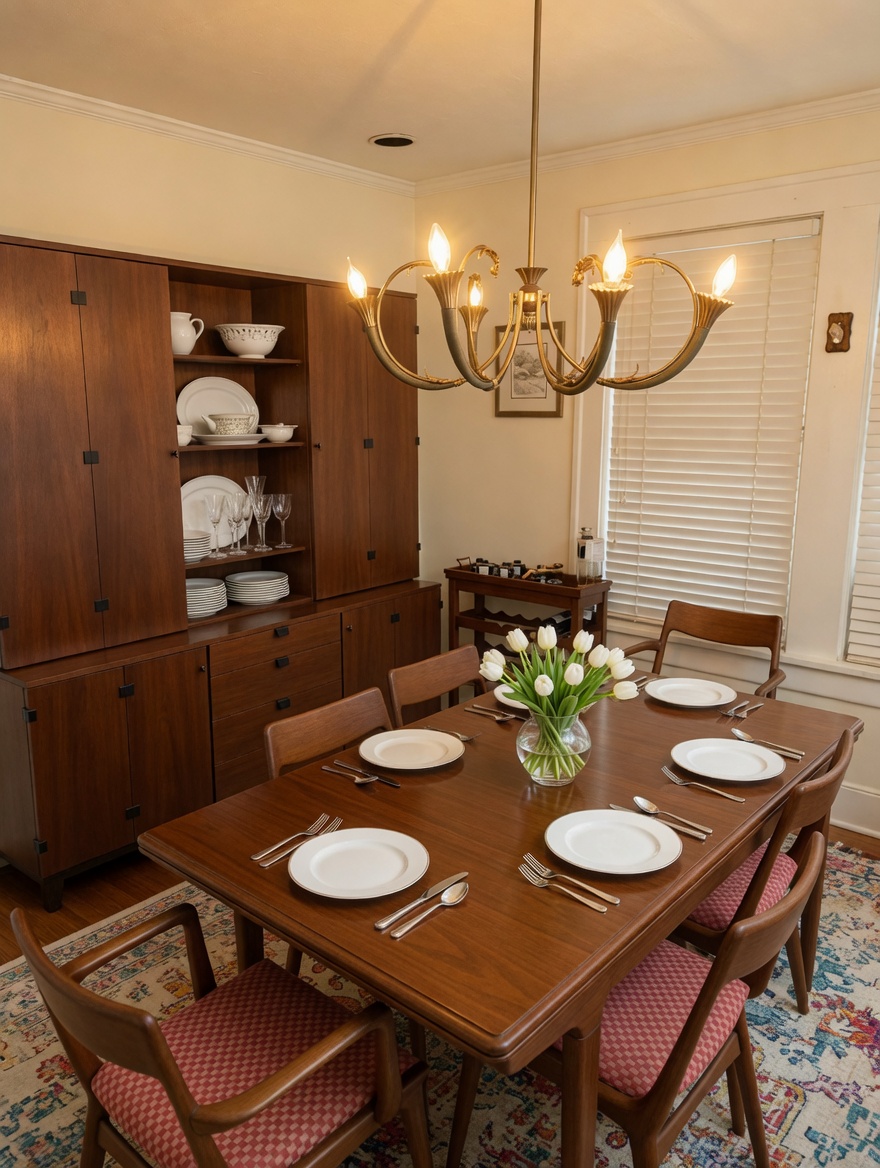
The chandelier announces the room.
A six-arm brass chandelier with cupped tulip sockets curls outward like deco trumpets, glowing warm against pale parchment walls. Beneath it, a walnut Danish-modern table set for six in cream china, white tulips clustered in a glass orb at center. The chairs are Niels Møller–school — sculpted backs, faintly Scandinavian, upholstered in muted carmine houndstooth that picks up the rose tones in the rug below.
Against the wall, a tall walnut credenza in two stacked volumes: closed cabinets bracketing an open display shelf of vintage white ironstone, mismatched stemware, a creamware tureen — the kind of china people actually use. A small bottle bar tucked beside it. Brass hardware throughout, all squared, no curves — the only curves in the room are overhead.
Kitchen
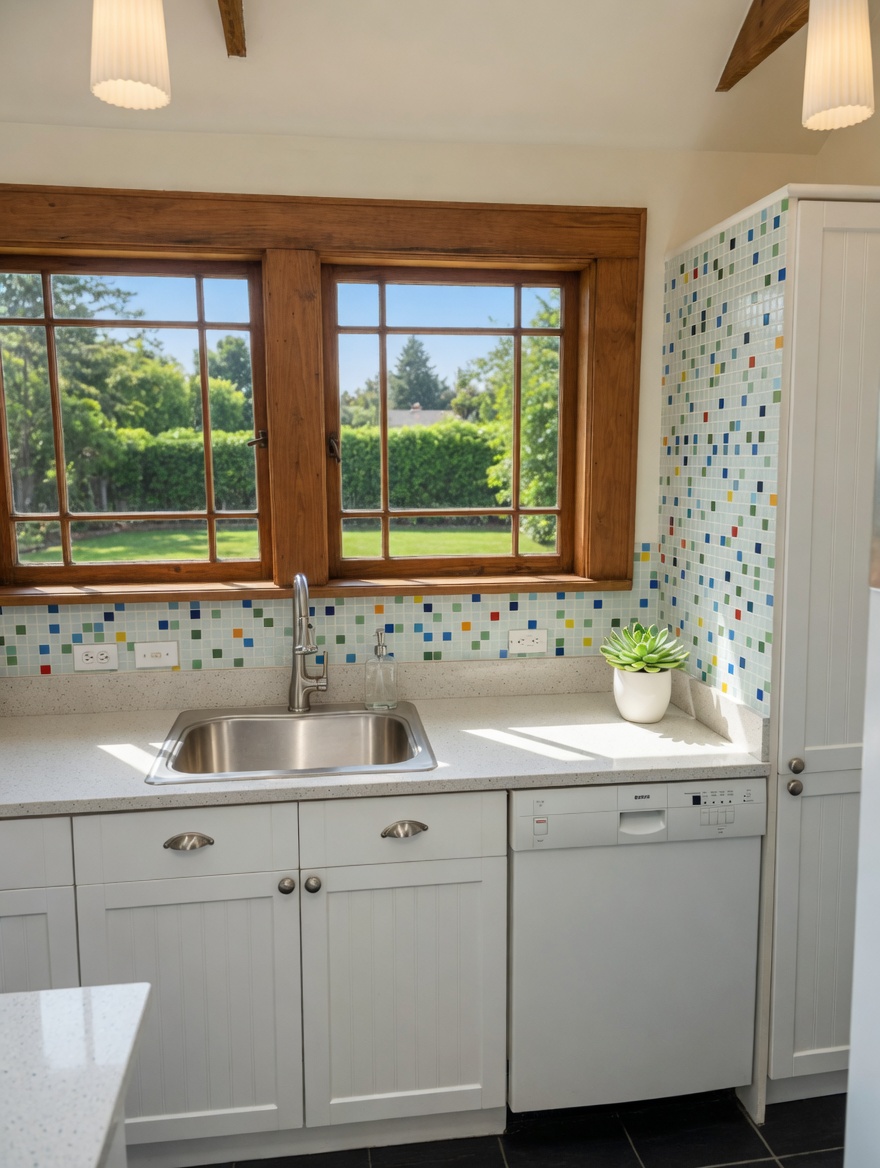
Two angles, one room.
White shaker beadboard cabinets with antiqued cup pulls, speckled quartz counters, a deep stainless basin under a pair of reclaimed-wood casement windows. The backsplash is the move — confetti glass mosaic in white, lake-blue, lime, primary red, and mustard, scattered like a Mondrian someone shook. Pleated pendant fixtures, exposed wood ceiling beam.
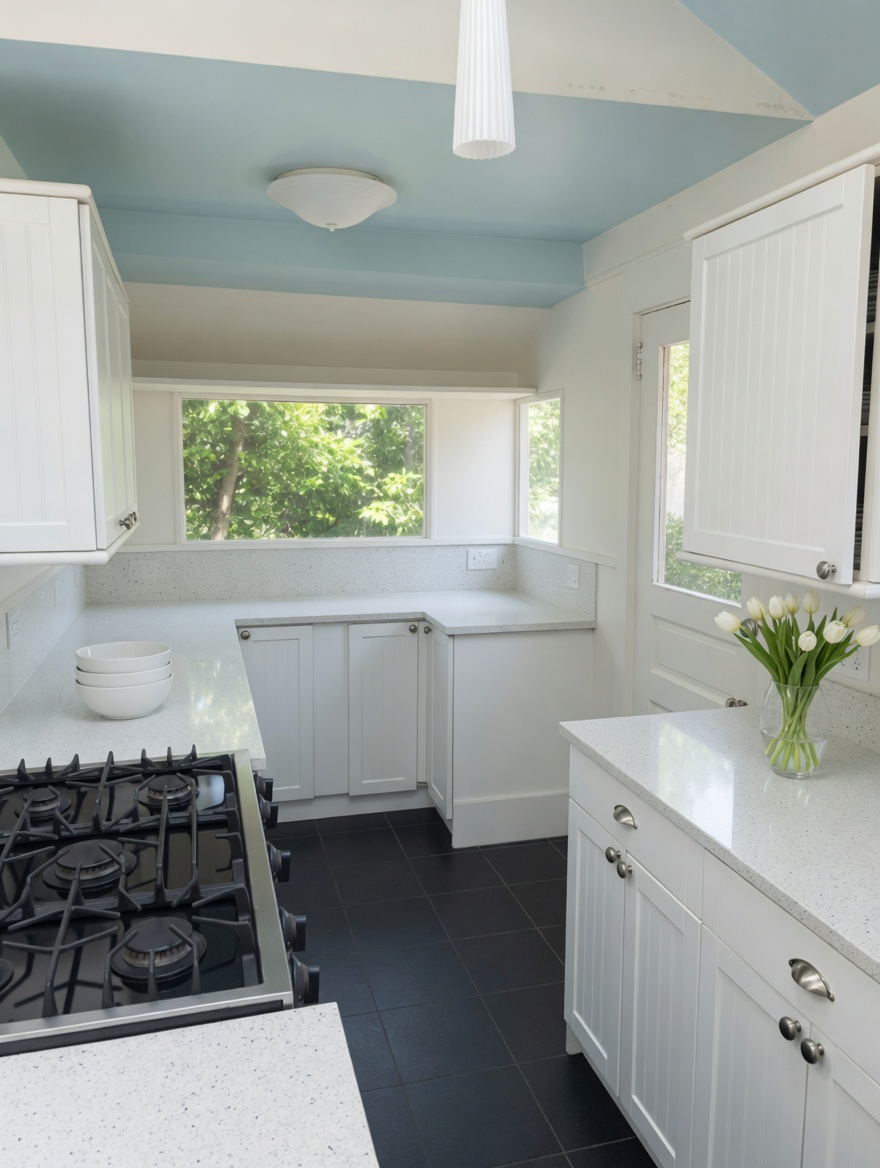
The opposite end opens up: a pale haint-blue ceiling — a Southern porch tradition smuggled indoors — a bank of windows over a ninety-degree counter run, black slate floor, black gas cooktop, and white tulips in a glass cylinder. Same materials, completely different mood. The haint-blue lifts the whole far wall.
Powder Room
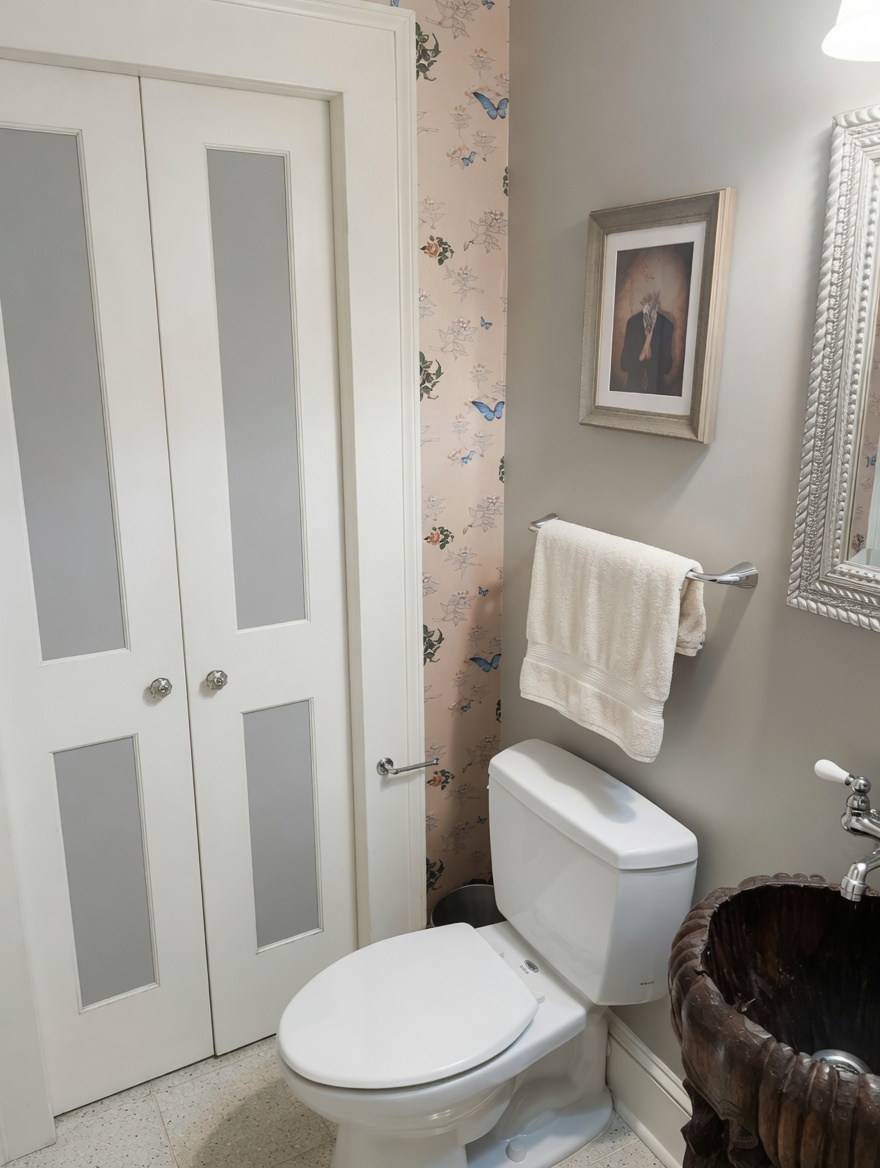
Small room, large ideas.
Three walls in soft warm grey; the fourth — a single accent strip — papered in a pale botanical print of butterflies and tiny fairies dancing among vines, half storybook, half Victorian fever dream. Above the toilet, a framed print of a figure whose head has been replaced by a bouquet (Magritte's cousin, contemporary).
The sink steals it though: a hand-hammered bronze scallop-shell basin, deep and dark, its rim crimped like a shucked oyster, paired with a porcelain-handled chrome faucet. Silver beaded mirror, frosted-glass bifold doors on the closet, speckled terrazzo floor. A room that takes thirty seconds to use and ten minutes to leave.
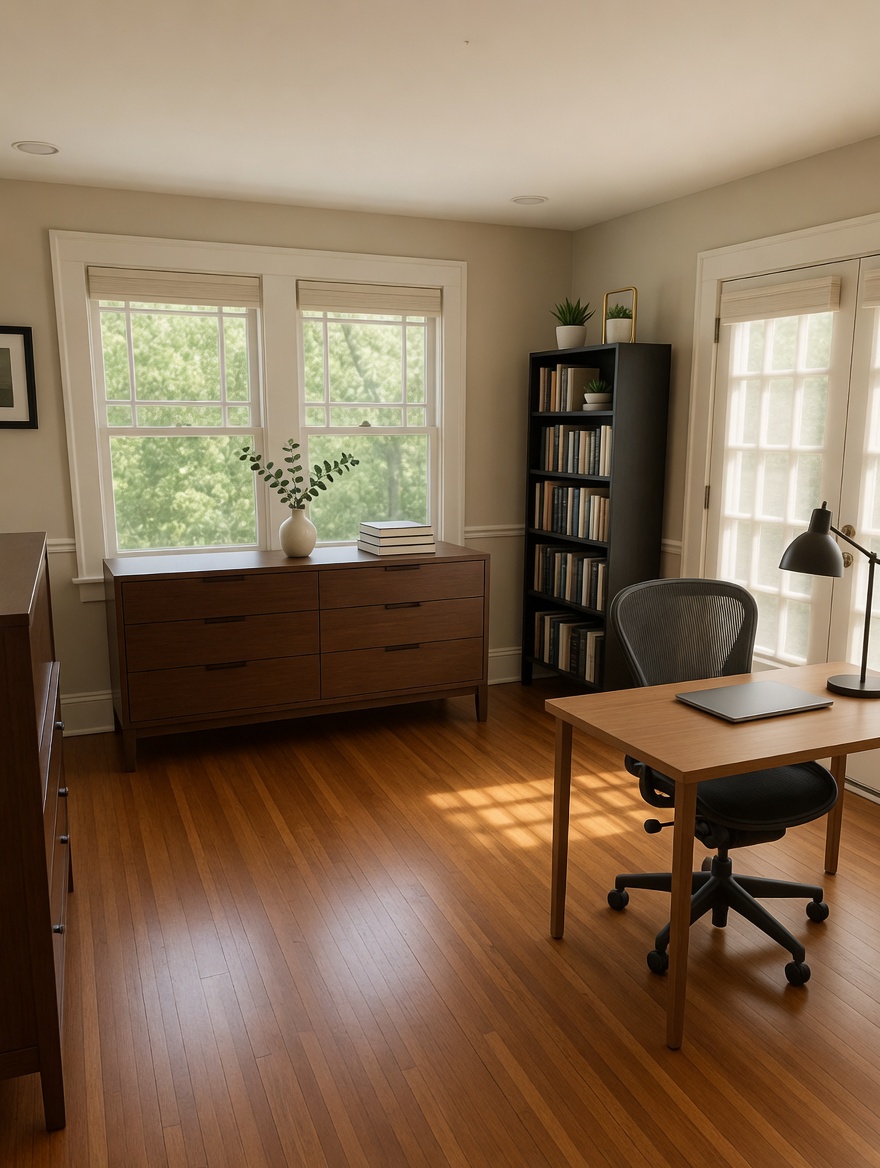
Study
The room where work actually happens.
Quiet room, north light. Cream walls, a dark walnut mid-century dresser under a pair of double-hung windows looking into the tree canopy — a eucalyptus sprig in a vase, two stacked books, the kind of staging that wasn't staged. A black metal etagere packed top to bottom with reading. An Aeron at a plain blonde-wood desk, anglepoise lamp, laptop closed. French doors on the right pour second-source light across warm bamboo-toned floors. No art on the walls.
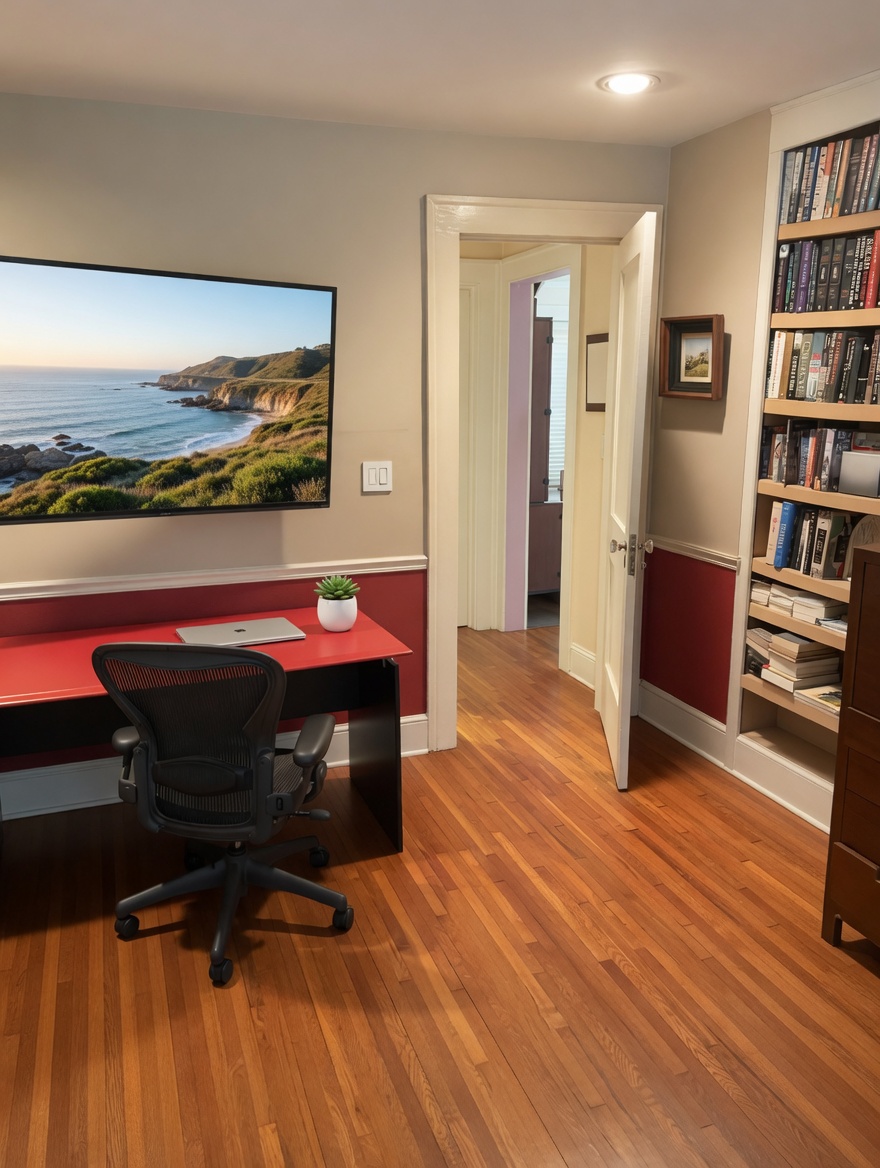
Den
The command post.
Smaller, redder, more declarative. A built-in red lacquer desk runs the length of the short wall under a wall-mounted display currently showing a Pacific cliffline at golden hour. Lower wainscot painted to match the desk; built-in bookshelves on the right packed with nonfiction. The doorway through to the lavender living room is visible in the distance — same Aeron as the study, but here the room reads command post rather than quiet reader.
Green Room
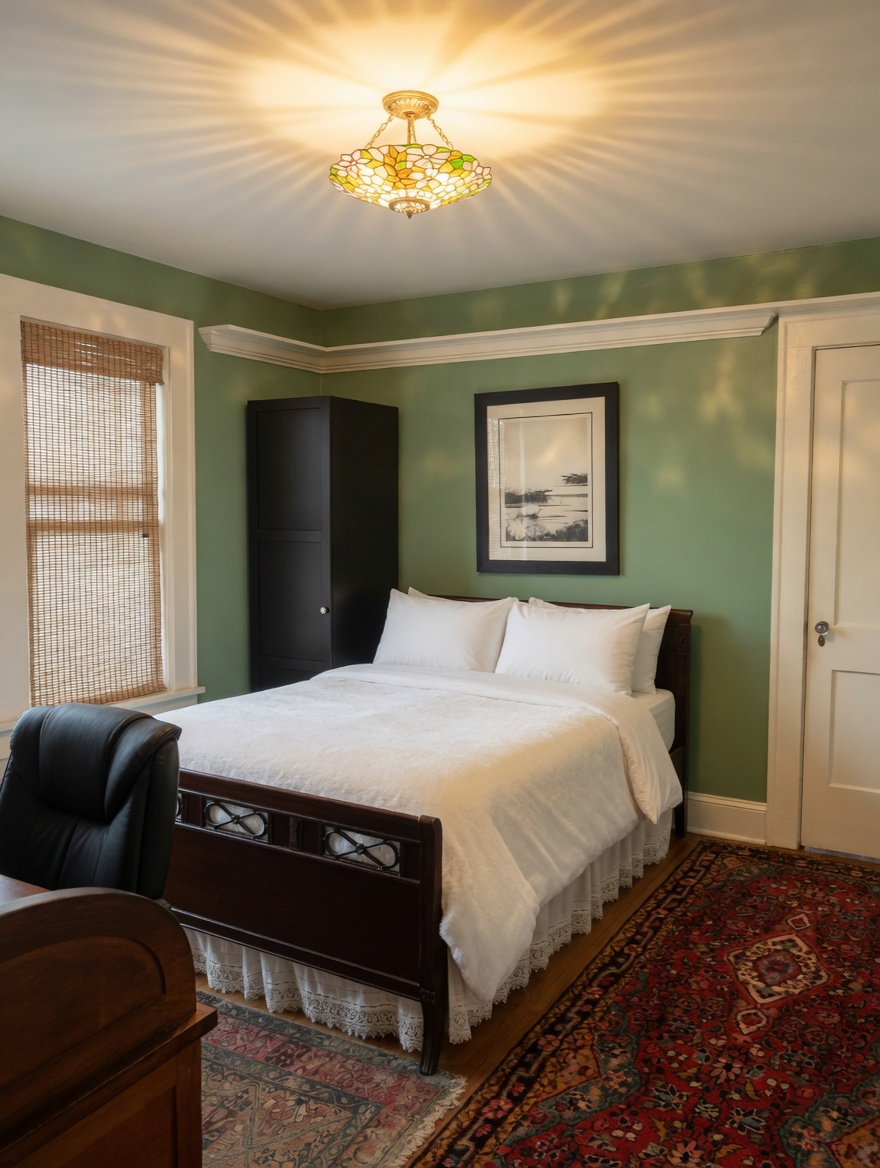
A guest room that admits its host actually works here.
Saturated sage walls — not pastel — with crisp white crown and trim cutting a clean horizon. The ceiling fixture is the punctuation: a Tiffany-style stained-glass semi-flush in gold, coral, and leaf-green that throws a sunburst across the ceiling. Below it, a dark mahogany sleigh bed with carved panel footboard, dressed in white duvet over a crocheted-edge bedskirt. A deep red Persian rug grounds it; a single framed black-and-white seascape sits above the headboard.
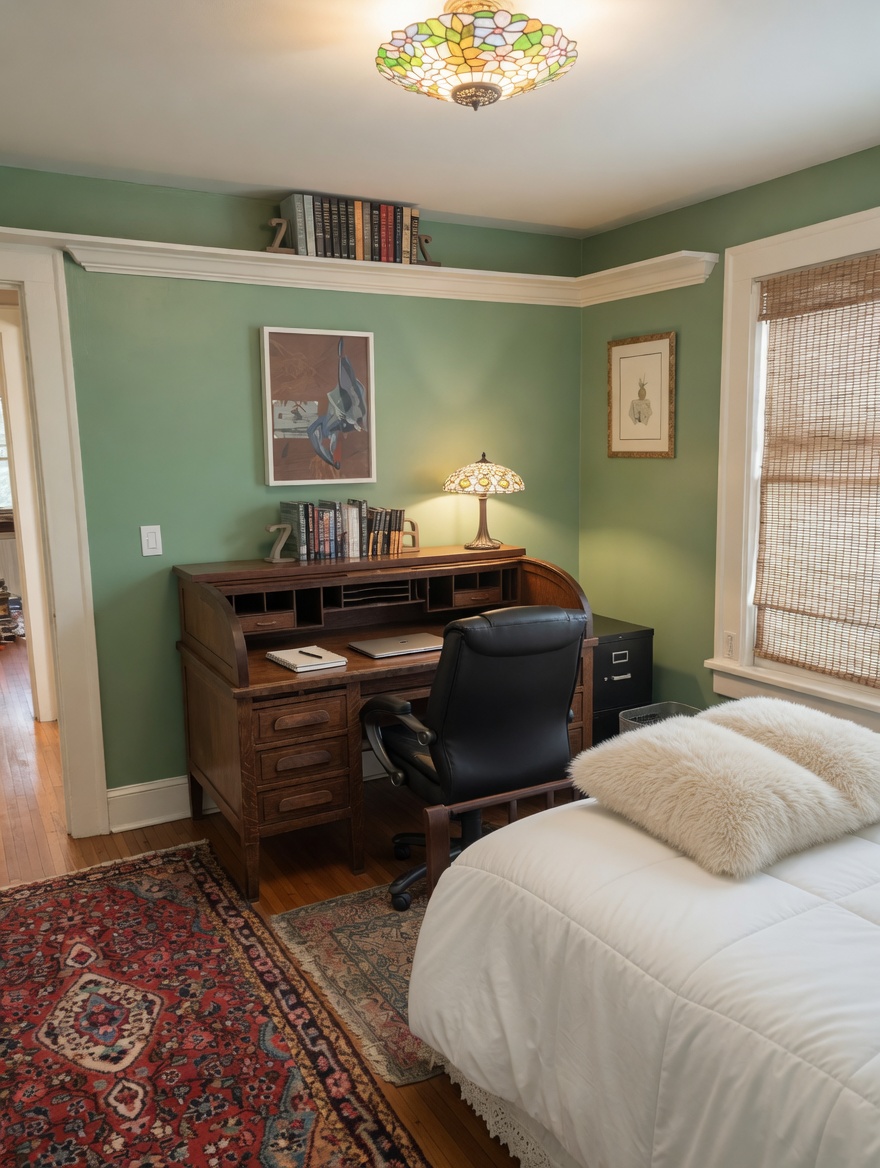
The far wall is where the room shows its real personality — an antique oak roll-top desk, cubbies and all, with a matching Tiffany table lamp throwing the same floral light as the ceiling. Black leather task chair, steel file cabinet tucked beside it, a high shelf running over the doorway loaded with book overflow. Two small framed prints — a bird study, a stag — quiet against the green.
The Stair
Centerpiece of the house, full stop.
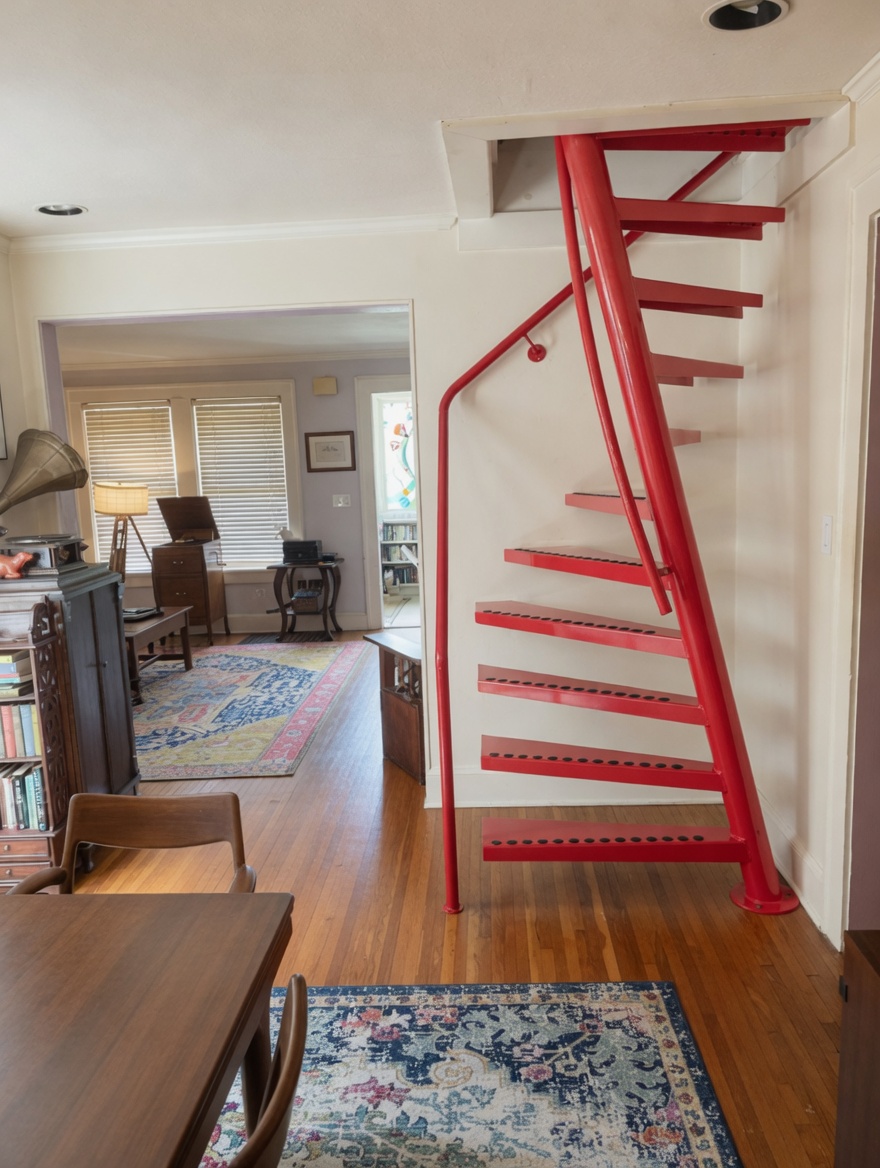
A fire-engine-red steel spiral staircase, perforated treads punched with a row of dots, twisting up through a cutout in the ceiling. The handrail bends in one continuous tubular gesture from floor to platform — industrial, almost playgroundish, completely unembarrassed.
It sits at the seam between rooms: dining room behind you, living room framed through the doorway ahead (the gramophone, the tripod lamp, the rose rug all visible from here). The contrast is the point — antique brass horn, century-old hardwoods, and then this defiant red coil refusing to pretend it grew up here.
Master Bedroom
The room at the top of the spiral.
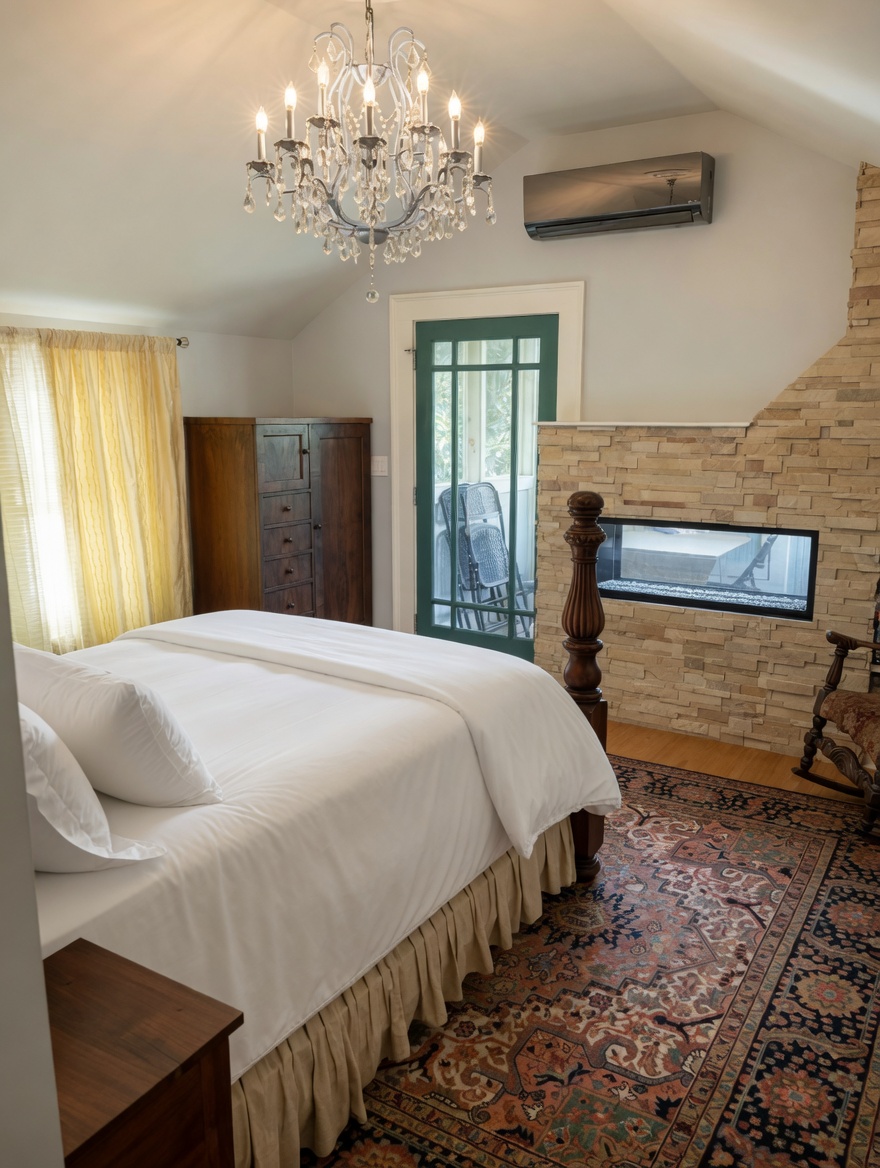
Cathedral ceiling, white walls, a crystal chandelier dripping from the peak — five arms, faceted drop crystals, the kind of fixture that would read fussy anywhere else but earns its keep up here against all that white plaster and exposed roofline.
A stacked-stone gas fireplace anchors the right wall — multi-toned ledgestone in warm sand and umber, with a long horizontal linear firebox set into it. A forest-green French door opens onto a small balcony over the deck.
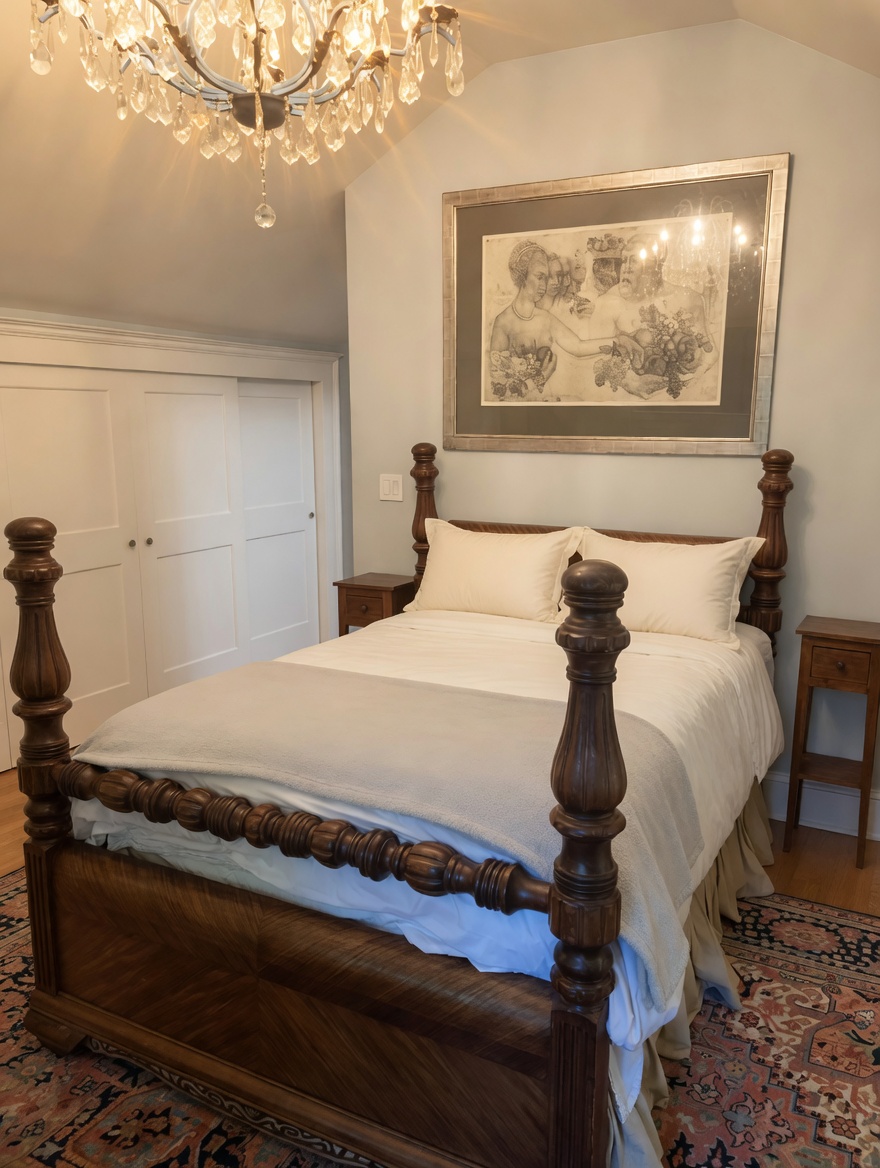
The bed is the antique of the house: a hand-turned mahogany four-poster, heavily lathed posts and a chunky baluster footboard, head and foot in deep figured walnut — Renaissance Revival, mid-1800s if pressed to guess. Dressed simply in white duvet and burlap-ivory bedskirt, two small walnut nightstands flanking. Over the headboard, a large framed graphite figure drawing — classical women with fruits and candelabra, the kind of piece you stop and read for a minute.
Sun Bath
The best room in the house, tied with the spiral stair.
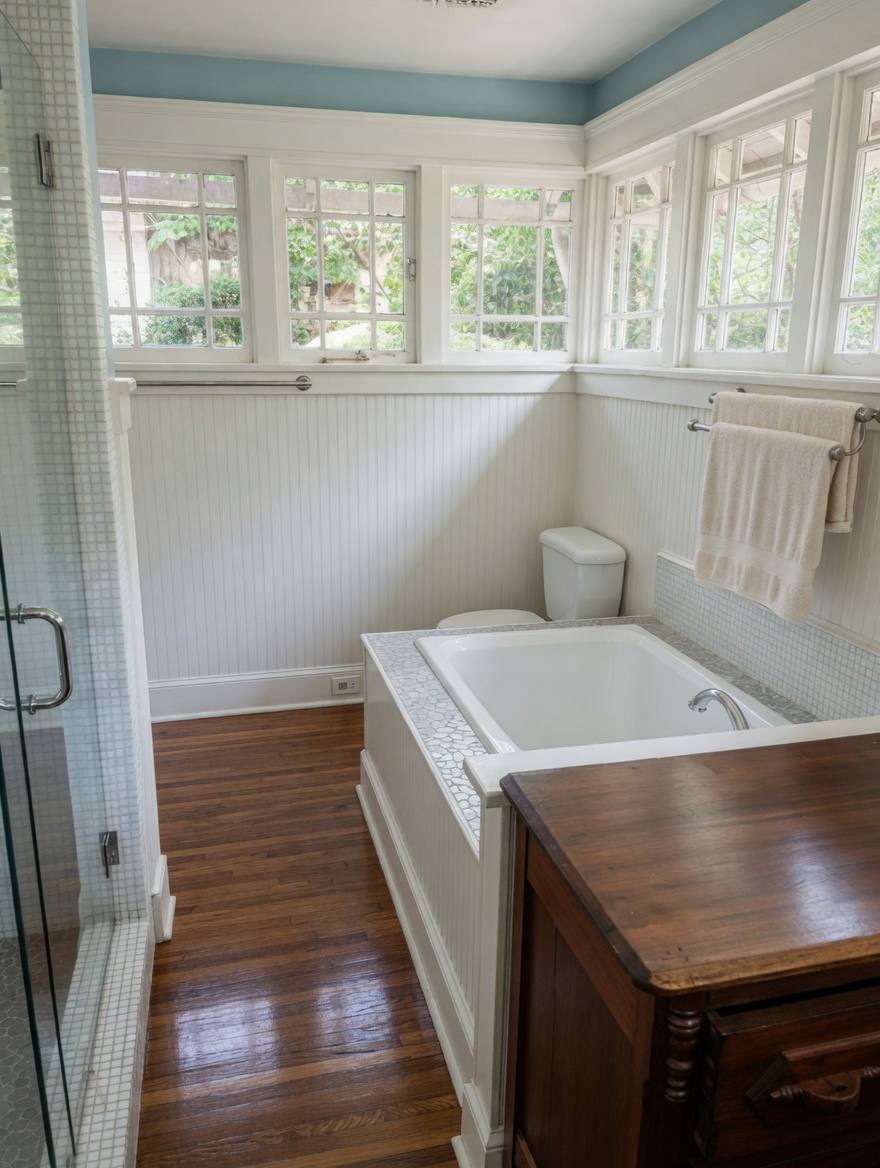
A wraparound band of divided-light casement windows runs the full perimeter at clerestory height — twelve panes, maybe sixteen — pulling tree canopy in on three sides. Below the windows, white beadboard wainscot from floor to sill; above, a haint-blue ceiling band matching the kitchen. The floor is warm oak, glossed up to take the moisture.
The room is split by a low half-wall: a glass shower on one side, soaking on the other. The drop-in tub is collared in a pebble mosaic — flat river-stone tile in pale grey-white, smooth enough to sit on, beadboard skirt below.
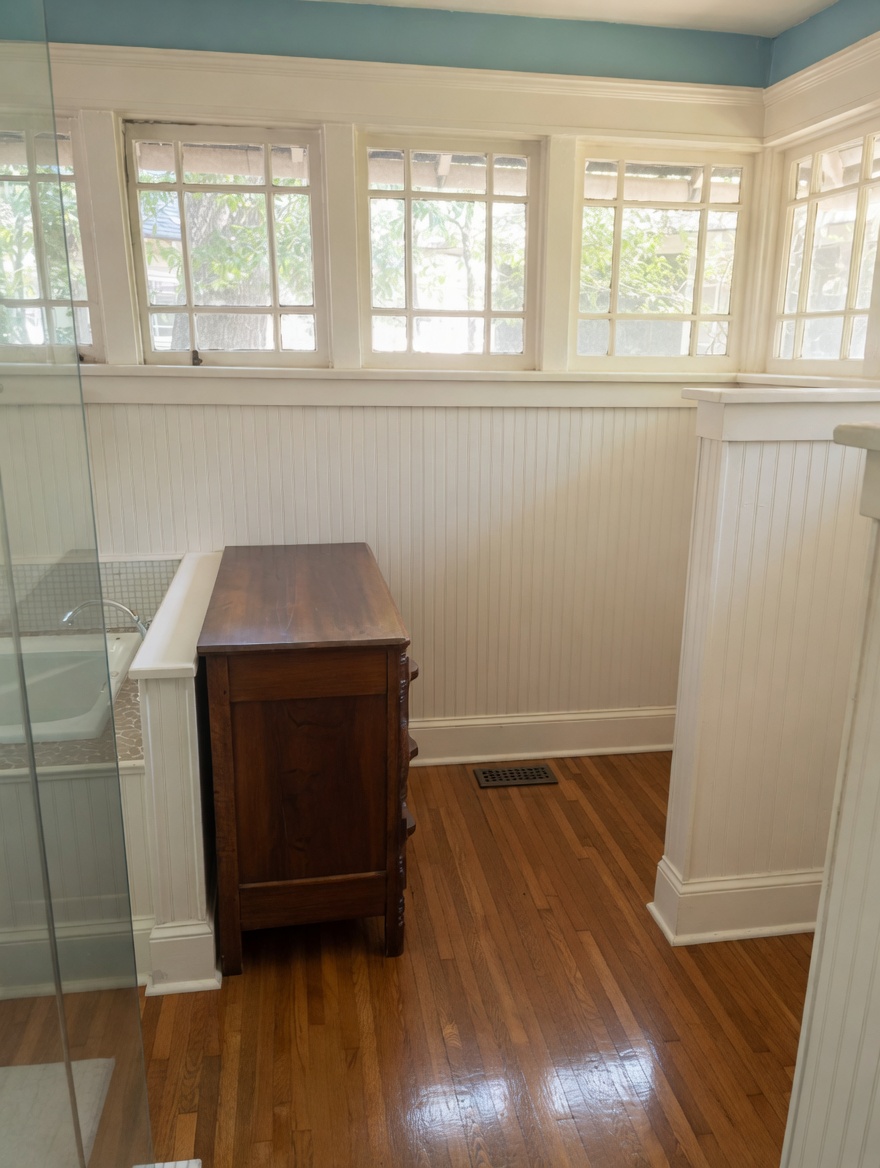
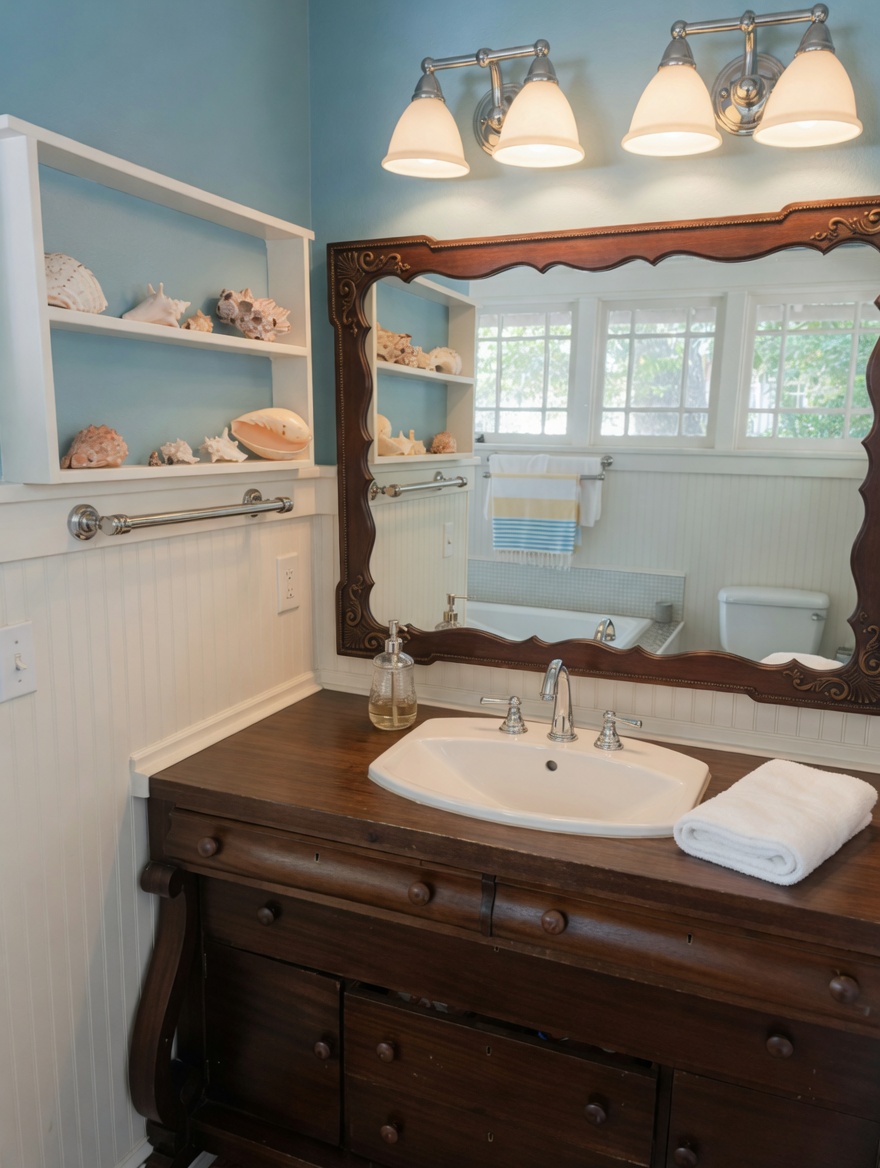
The vanity is the move: an Empire-era antique dresser in dark walnut — scroll legs, ball pulls, the works — with its top fitted with a modern drop-in porcelain basin and a chrome bridge faucet. Above it, a carved wood mirror that looks like a sibling of the dresser, flanked by a four-globe brushed-chrome sconce.
And above the mirror, a single white open shelf staged with a conch and lambis shell collection that says somebody's been to the coast and brought receipts. Striped Turkish towel on the bar. Haint-blue walls finish the corner. It's the bathroom of someone who'd happily read in the tub for an hour.
Attic Bath
The smaller bath, with the stained-glass tree.
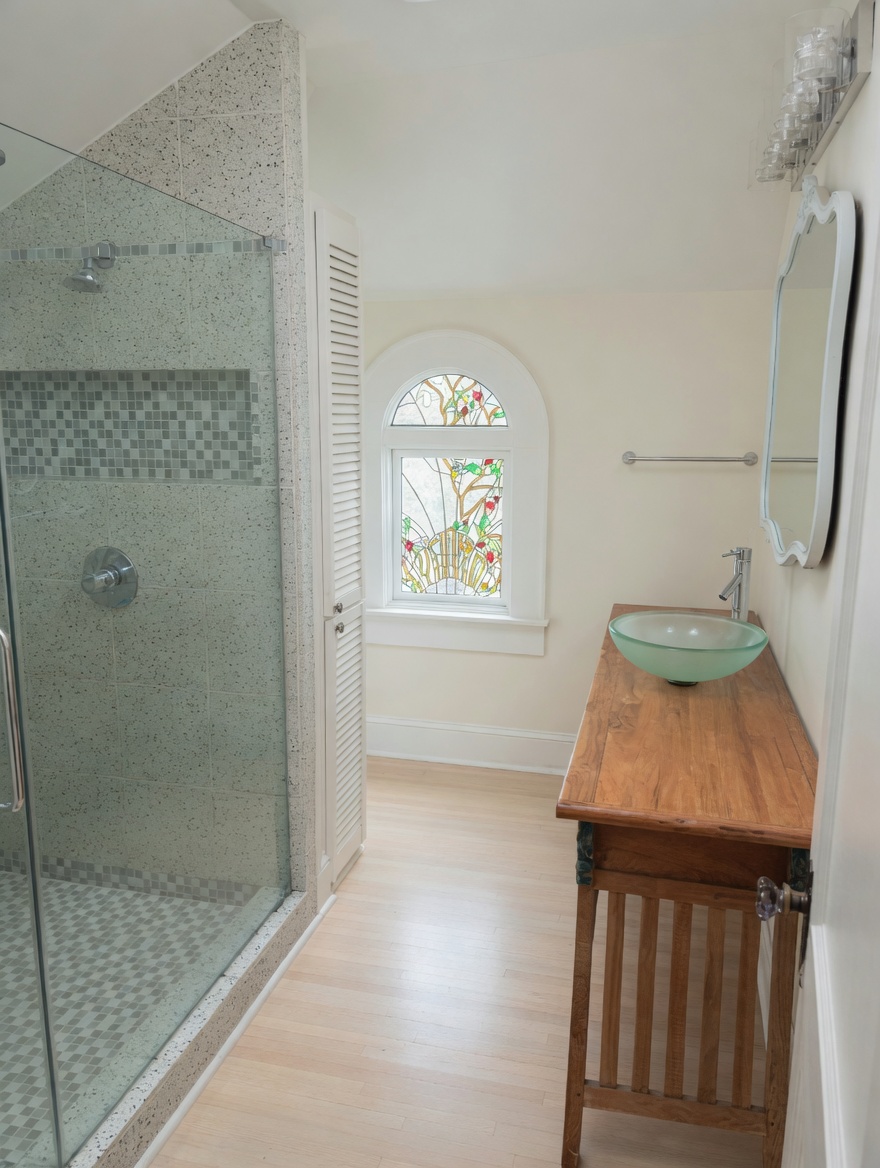
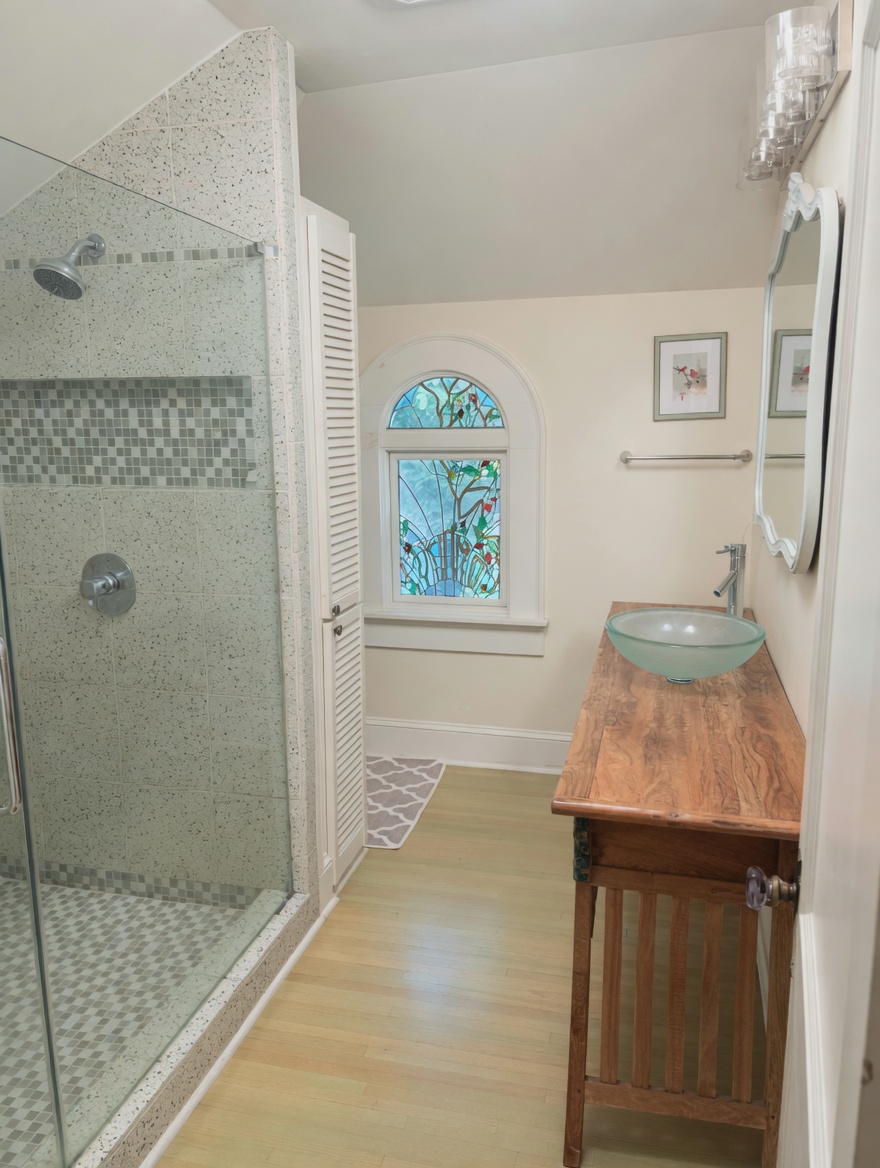
Tucked under the roofline — the sloped wall gives it away. Cream walls, pale bamboo floors, a glass-enclosed shower in flecked terrazzo tile with a mosaic accent stripe. The vanity is a slim Mission-style console in honey oak, slat sides, open below for towels, fitted with a seafoam frosted-glass vessel sink and a chrome wand faucet. A curvy white-framed mirror above.
But the window is the moment: a small arched stained-glass panel depicting a stylized tree heavy with red berries, gold sun-rays radiating behind it against a blue sky — possibly the same hand as the reading-nook vines. It throws colored light onto the floor when the sun is right.
Treetop Nook
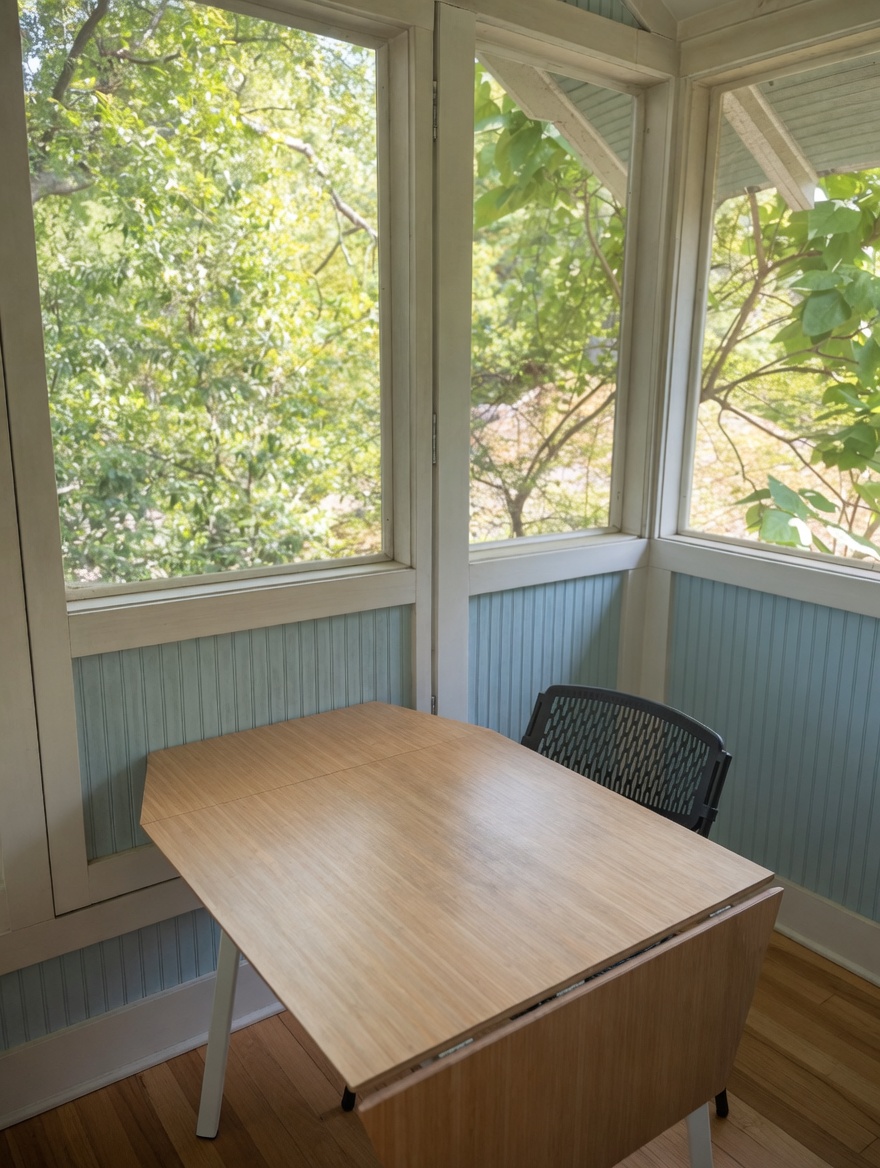
A writing carrel pretending to be a tree fort.
An upstairs perch — eye-level with the leaf canopy, not above it, not below it, in it. Three tall windows wrap two walls, pale duck-egg-blue beadboard wainscot below sill height, white trim and exposed rafter ends in the corner that betray the room as a converted dormer off the screened porch.
Warm bamboo floor. The furniture is one minimal drop-leaf bamboo desk and a single black mesh chair — nothing else, nothing needs to be. The room is the view.
Laundry
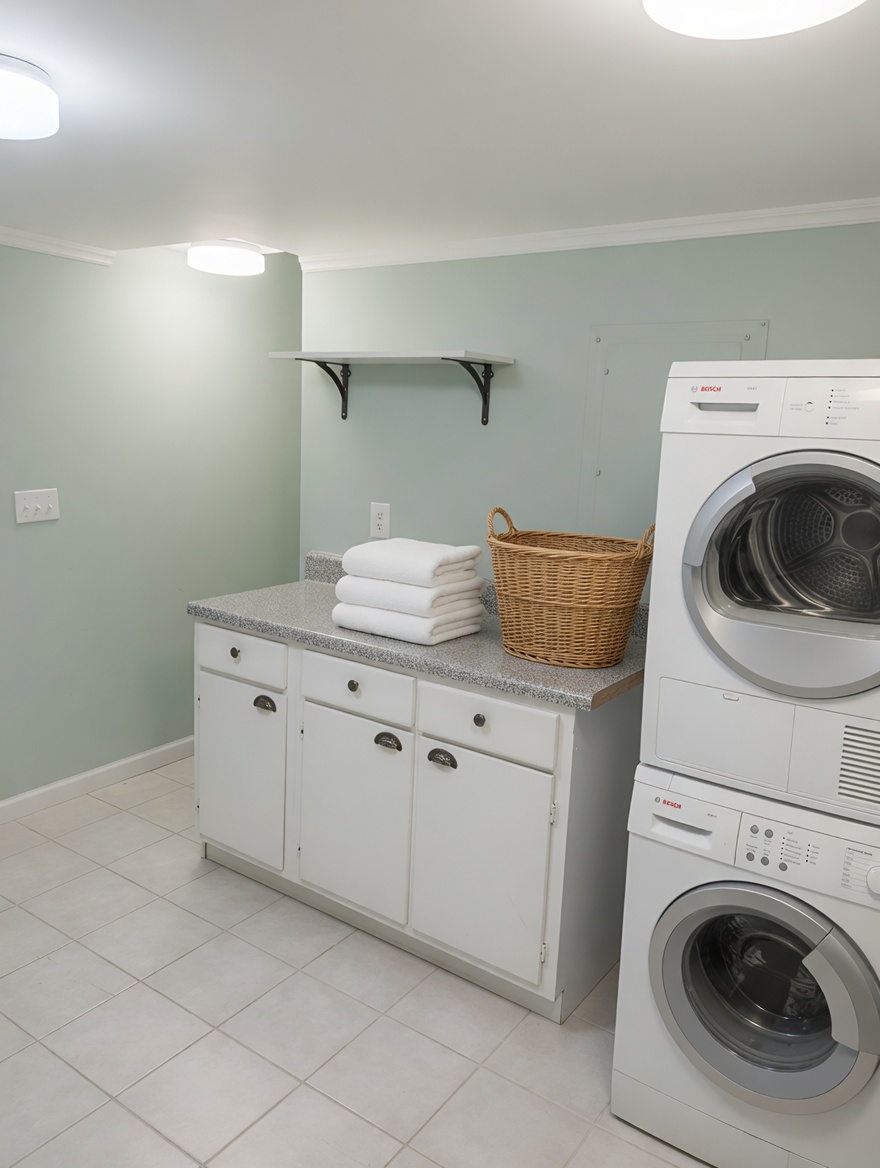
The half-basement, calm and useful.
Sage walls, white tile floor, a vintage white cabinet base with cup pulls and a speckled terrazzo-look counter — the kind of millwork the previous owner painted instead of replaced, all the better for it. Stacked Bosch compact front-loaders. A wicker hamper, a stack of folded white bath towels staged like a B&B, and a single white wall shelf on black iron brackets above the counter.
Floor Plan
Upstairs.
The second floor, added in the renovation: master bedroom and master bath, screened porch off the east, and a small treetop nook tucked into a dormer at the north corner. The downstairs plan is yet to be drawn.